Bitcoin just delivered another reminder of how hard it is to change the protocol. The BIP-110 rejection — more precisely, the failure of the Reduced Data Temporary Softfork to win meaningful network consensus — became clear over the weekend of August 8–9, 2026, when mandatory signaling began and a tiny minority chain stalled almost immediately.
For most holders, the main Bitcoin chain kept producing blocks as usual. For Bitcoin governance, the episode is larger than a single soft fork. It shows how Bitcoin upgrades and proposals live or die: not by marketing, not by node counts alone, and not by a loud social-media campaign, but by economic consensus.
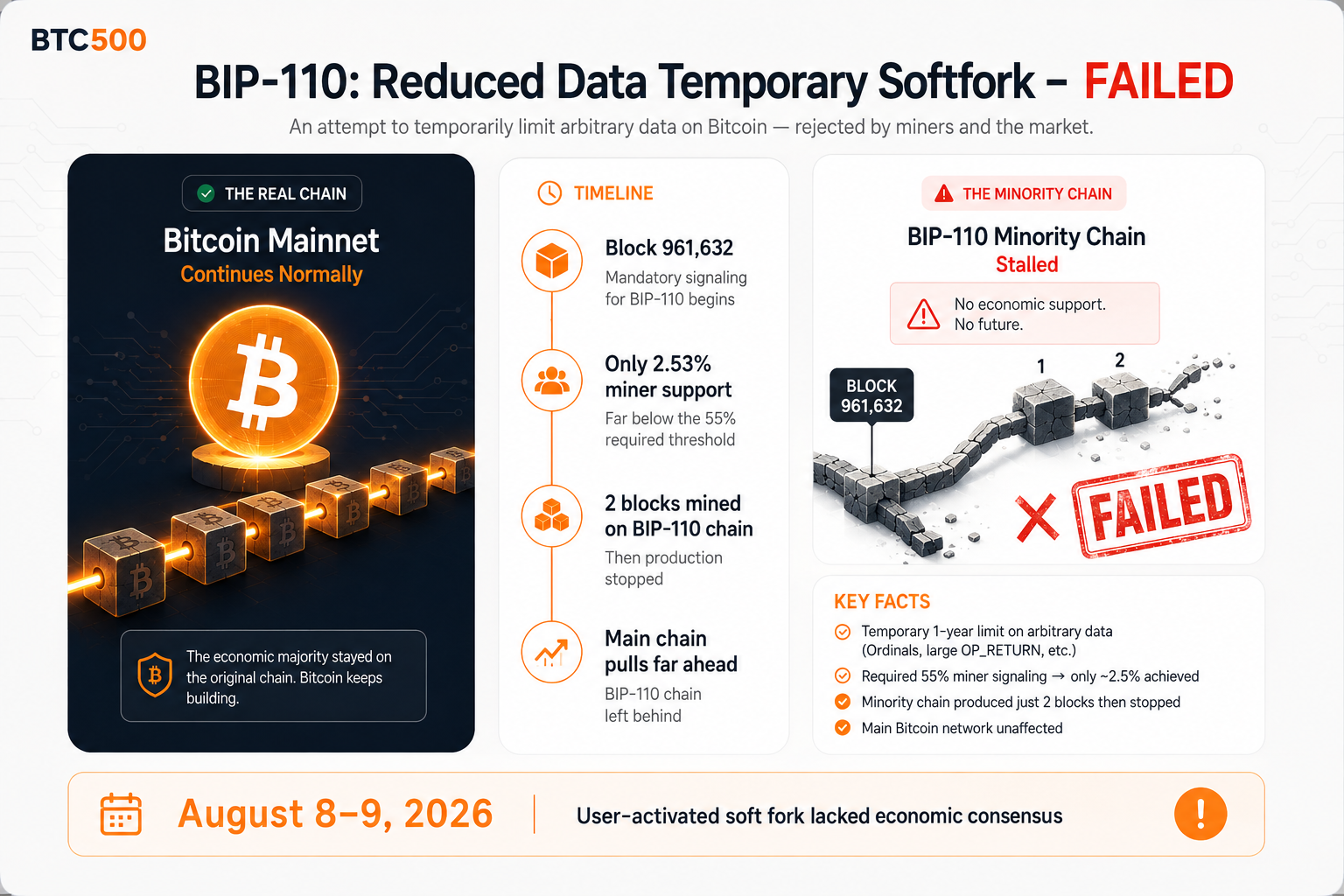
Key takeaway: BIP-110 did not change Bitcoin’s consensus rules. The economic majority stayed on the existing chain, miner signaling never approached the proposal’s 55% threshold, and the breakaway BIP-110 chain produced only a couple of blocks before effectively stopping.
What Is BIP-110?
Bitcoin Improvement Proposal BIP-110, formally titled the Reduced Data Temporary Softfork, was a proposed soft fork designed to temporarily limit how much arbitrary data can be embedded in Bitcoin transactions.
Supporters framed it as a defense of Bitcoin’s monetary purpose. After the rise of inscription-style techniques and other non-financial data uses, they argued that large data payloads burdened node operators, competed with payments for block space, and distracted development energy away from Bitcoin as money.
In practical terms, the proposal aimed to:
- Temporarily restrict large arbitrary data fields at the consensus layer
- Limit certain output sizes, data pushes, and Taproot-related data patterns
- Apply those limits for roughly one year (about 52,416 blocks)
- Grandfather pre-existing UTXOs so older coins would generally remain spendable under the old rules
The problem it tried to solve was not abstract. Since 2022–2023, debates over Ordinals, inscriptions, BRC-20-style tokens, Runes, and large OP_RETURN-style data have divided the community. One camp sees these uses as fee-paying free speech on a neutral network. The other sees them as spam that raises costs and dilutes Bitcoin’s identity.
BIP-110 was one attempt to settle that fight with a temporary consensus rule change rather than with relay policy alone.
Why Was BIP-110 Rejected?
There is no single central “vote count” that officially rejects a Bitcoin proposal. In practice, BIP-110 failed because it never secured the multi-constituency consensus Bitcoin requires. Several overlapping reasons explain why BIP-110 was rejected by the broader network.
1. Technical concerns
Critics argued that BIP-110 was not a clean, low-risk change. Soft forks that reject previously valid transaction patterns can create edge cases for wallets, contracts, and advanced Taproot constructions. Some developers also argued the proposal would not fully stop data embedding — only push it into different encodings — while still adding complexity and temporary rule dualism.
Another concern was activation design. BIP-110 used a relatively low 55% miner-signaling threshold for early lock-in and included a mandatory signaling phase in which BIP-110-enforcing nodes would reject non-signaling blocks. That structure raised the probability of a messy split if economic consensus was missing.
2. Community disagreement
The community never aligned. Parts of the Bitcoin Knots and anti-spam node operator community supported the idea. Bitcoin Core did not adopt the proposal as a network-wide upgrade path. Major mining pools largely declined to signal. Influential public voices — including corporate Bitcoin advocates and long-time protocol figures — opposed changing consensus rules to police transaction content they considered fee-paying and valid under current rules.
That disagreement mattered more than any single technical clause. Bitcoin upgrades and proposals succeed only when developers, miners, node operators, exchanges, custodians, and users broadly converge on the same chain rules.
3. Security, centralization, and complexity risks
Opponents repeatedly raised three risk categories:
- Chain-split risk: Without broad economic buy-in, a user-activated soft fork can isolate enforcing nodes instead of upgrading the network.
- Precedent risk: Changing consensus to invalidate some currently valid, fee-paying transactions looked to many like a form of content-based rule-making.
- Complexity risk: Temporary rules force wallets, contracts, and infrastructure to reason about two regimes — during the deployment and after expiry — which is the opposite of Bitcoin’s usual preference for predictable, long-lived rules.
How Bitcoin Governance Works
The Bitcoin governance process is deliberately slow, informal, and multi-layered. There is no foundation CEO who can ship a protocol change, and no tokenholder vote that can force one.
In simplified form, Bitcoin upgrades usually move through these stages:
- Idea and draft: A developer or group writes a BIP describing the motivation, design, and activation path.
- Review: Other developers critique security, incentives, and edge cases on mailing lists, code review, and public discussion.
- Implementation: Compatible software is written and tested. Users and miners choose which software to run.
- Economic consensus: Miners, exchanges, custodians, businesses, and users converge on which rules are “Bitcoin.”
- Activation: Only then does a soft fork become a real network upgrade rather than a minority experiment.
Consensus is hard because every constituency can block change. Developers can refuse to merge code. Miners can refuse to signal or mine under new rules. Node operators can refuse to enforce them. Markets can refuse to price a minority fork. That friction is not a bug in Bitcoin’s design. It is the design.
Bitcoin’s conservative approach exists for a reason. Once rules change, trust assumptions change with them. Holders, exchanges, and long-lived contracts need to know that valid today will still mean valid tomorrow unless an overwhelming case for change exists.
Governance lesson: Bitcoin is not governed by the loudest timeline or the largest temporary node share. It is governed by who runs economically relevant software and which chain the market treats as Bitcoin.
Market and Community Reaction
Sentiment around the BIP-110 rejection split along predictable lines.
Many developers and protocol conservatives treated the outcome as confirmation that consensus-layer content restrictions remain extremely hard to pass. From that perspective, the proposal’s failure reaffirmed neutrality and caution.
Anti-spam advocates saw something different: a missed opportunity to push back against non-monetary data and rising long-term node costs. For them, the technical and cultural problem remains open even if this particular soft fork did not stick.
Traders and market participants mostly cared about one operational question: does this create a meaningful chain split or exchange-listed fork coin? Early evidence suggested no. The BIP-110 minority chain lacked meaningful hashrate, major exchange support, and durable liquidity. Reporting after the mandatory window opened indicated the breakaway chain mined only about two blocks and then stalled while the main chain continued normally.
Social discussion followed the usual Bitcoin pattern: technical threads about activation mechanics, governance arguments about censorship versus neutrality, and practical warnings for users running BIP-110-enforcing node software who might have fallen out of sync with mainnet.
What the BIP-110 Rejection Means
The BIP-110 rejection is a signal, not a full resolution of the data debate.
A signal for future proposals
Future Bitcoin upgrades and proposals will likely face the same test: broad economic alignment before aggressive activation. Low thresholds and mandatory enforcement without market buy-in are more likely to produce minority chains than network-wide rule changes.
Innovation versus stability
Bitcoin can still innovate — through soft forks that do earn consensus, through second layers, and through policy-level tooling. What it resists is rapid consensus mutation driven by cultural conflict. Stability won this round. That does not mean every future proposal will fail. It means the bar remains high.
Long-term implications
Long term, the episode reinforces three structural facts:
- Bitcoin’s base layer is hard to re-politicize through short campaigns
- Node software choice matters operationally, but markets still define which chain is economically relevant
- Debates over blockspace use will continue, likely through policy, market fees, and revised proposals rather than one decisive culture-war soft fork
What This Means for BTC500 Investors
For cycle investors following the BTC500 framework — accumulate roughly 500 days before a halving, hold through expansion, and sell about 500 days after — protocol theater is rarely the main event. Custody, liquidity, and position discipline usually matter more than weekend fork headlines.
The Core Strategy Still Holds
HOLD: through the cycle
SELL: 500 days after halving
Governance drama can create noise. Cycle process is still the edge.
The practical investor takeaway from BIP-110 is operational, not philosophical:
- Confirm your wallet or exchange follows Bitcoin mainnet consensus
- If you run custom node software, know exactly which rules it enforces before a soft fork window opens
- Treat minority-chain coins, if any appear, as high-risk experiment assets — not as a free bonus that is safe to sell casually without understanding replay risk
- Do not let governance noise force emotional trades outside your cycle plan
What Happens Next?
Several paths remain open after the BIP-110 rejection:
- Possible revisions: Supporters may refine the idea, raise the quality of technical review, or pursue a less aggressive activation path.
- Alternative proposals: Some discussions already point to stricter or differently designed anti-data proposals, while others prefer non-consensus approaches such as relay policy changes.
- Broader Bitcoin roadmap: Separate upgrade conversations — privacy, scripting, covenants, scaling layers, and quantum readiness — will continue on their own timelines. BIP-110’s failure does not freeze the entire roadmap; it only shows that contested content-filtering soft forks face extreme resistance.
For now, Bitcoin’s consensus rules remain where they were before the weekend drama. The minority experiment can exist as software. The market does not have to price it as Bitcoin.
Key Takeaways
- BIP-110 was rejected because it never earned broad miner, market, or multi-constituency consensus — signaling stayed near low-single-digit percentages.
- Bitcoin remains conservative. Changing consensus rules still requires far more than a passionate minority and a completed BIP document.
- Governance is slow but intentional. The friction that frustrated BIP-110 supporters is the same friction that protects long-term holders from casual protocol experiments.
- Mainnet continued normally. The practical investor impact was small unless someone intentionally followed the minority ruleset.
- The data debate is not over. Only this activation path failed. The underlying argument about blockspace use continues.
FAQ
What is BIP-110?
BIP-110 is the Bitcoin Improvement Proposal for a “Reduced Data Temporary Softfork.” It proposed temporary consensus limits on arbitrary data in transactions, aimed largely at non-financial data embedding techniques.
Why was BIP-110 rejected?
It failed to secure meaningful economic consensus. Miner signaling stayed far below the proposal’s 55% threshold, major pools did not back it, Bitcoin Core did not adopt it as a network-wide upgrade, and the resulting minority chain stalled after minimal block production.
How are Bitcoin proposals approved?
There is no single approval board. A BIP becomes a real upgrade only when software implementing it is widely reviewed, run, and economically recognized as Bitcoin by miners, nodes, exchanges, businesses, and users.
Does the BIP-110 rejection affect Bitcoin price?
Protocol governance events can create short-term narrative noise, but BIP-110’s failure did not rewrite Bitcoin’s monetary policy, issuance schedule, or mainnet rules. Any price impact depends on broader market conditions, not on the mere existence of a failed soft-fork attempt.
Do I need to do anything as a Bitcoin holder?
Most holders on standard wallets and exchanges need no action. People running BIP-110-enforcing node software should verify whether their node is still following mainnet. Anyone tempted to trade minority-chain coins should understand replay risk and liquidity risk first.
Bottom Line
The BIP-110 rejection is best understood as a governance stress test. A contentious soft fork tried to force a temporary cultural and technical preference into Bitcoin’s consensus rules. The network answered the way it often does when consensus is missing: the main chain continued, the minority path lost economic relevance, and Bitcoin’s conservative upgrade culture was reinforced.
That outcome will disappoint people who wanted a decisive anti-data rule change. It will reassure people who prioritize neutrality and predictability. For long-term holders, the useful lesson is simpler: Bitcoin’s base layer still changes slowly, on purpose — and that is a feature of the system, not a failure of it.