Doctor Profit spent the first week of October building a Bitcoin short at $86,200 and telling roughly 522,000 followers that his target was $79,000. Less than two weeks later he had closed it near $80,600, bought spot, and raised a $94,000 target. On 21 October he added that a quick squeeze to $86,000 could come first, followed by a stronger move to $94,000.
That is not a contradiction. It is a trade. But the speed of the flip — and the certainty of the language around it — makes a useful case study in how to read a high-follower trader without outsourcing your own risk management.
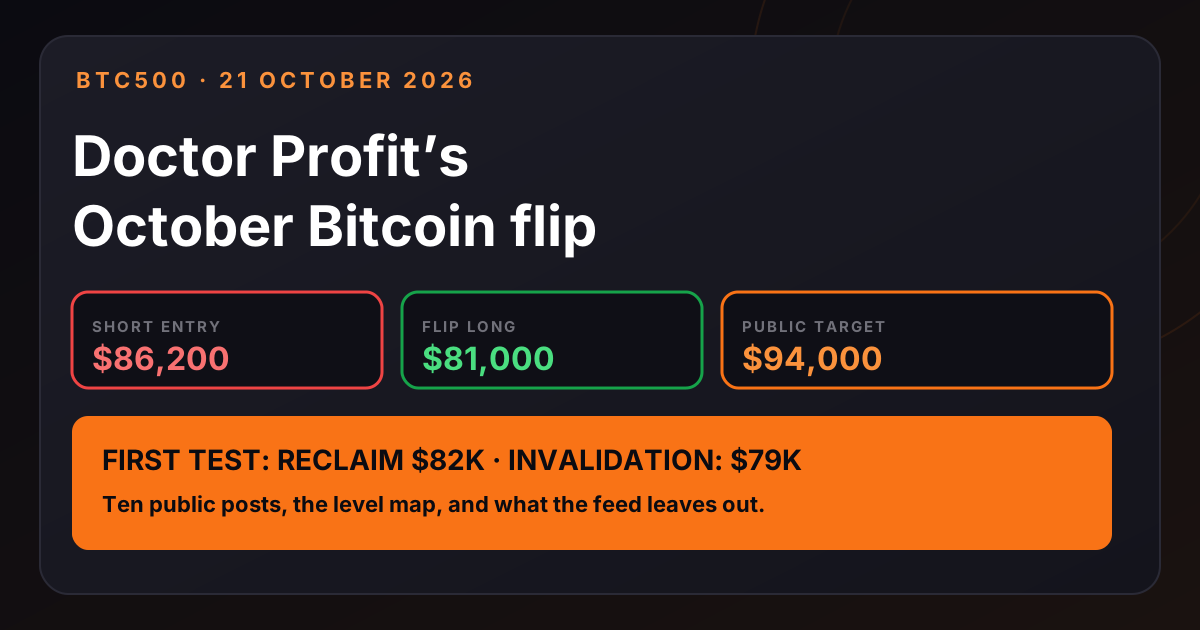
Snapshot, 21 October 2026: short $86,200 → exit near $80,600 → long $81,000 (4x) → first confirmation $82,000 → range $82,000–$88,000 → target $94,000. Invalidation: loss of $81,000–$82,000, then $79,000. These are his published levels, paraphrased. Not financial advice.
Who is Doctor Profit?
Doctor Profit is a pseudonymous trader who posts as @DrProfitCrypto on X. His bio describes him as an elite trader focused on Bitcoin, stocks, and trading psychology, with the standard disclaimer that the content is educational and not financial advice. He also sells a premium subscription, which matters when reading the free feed: every public post is both analysis and marketing.
His public story is that he sold the 2025 top near $124,000, shorted the decline, and covered near $60,000. That sequence is the foundation of his current credibility. It is also the part an outsider cannot verify. We can verify what he posted and when. We cannot verify the fills, the size, or the equity curve behind them.
The last ten posts, in order
The feed reads like a trade journal if you put it in sequence. The important detail is not the direction — it is that the invalidation and the next level were published before the move.
| When | What he posted | The market takeaway |
|---|---|---|
| 1 Oct | Opens a swing short at $86,200, with adds between $86,500 and $89,500. First target $79,000; deepest case $69,000–$71,000. | A defined bearish trade inside a bull market — not a call for a new bear market. |
| 7 Oct | Explains the ladder: several orders, 2x leverage, an average near $87,900 if all fill. Says altcoin volume is roughly 4x Bitcoin’s and he is out of ONDO and HBAR. | Leverage and position sizing are disclosed, and risk is cut elsewhere in the book. |
| 12 Oct | Closes the short near $80,600, buys spot, and flips bullish. Target $94,000. Path: reclaim $82,000, chop between $82,000 and $88,000, then break out. | The flip is pre-announced with a level, not just a change of mood. |
| 15 Oct | Bitcoin retests the daily MA50. He expects the average to hold and price to keep moving higher. | Trend-following logic: the moving average is the line in the sand. |
| 18 Oct | The Big Sunday Report: the bearish RSI divergence he flagged at $87,000 played out, the correction is “completed,” and he is long at $81,000 with 4x leverage. | The core thesis: the $86,000–$88,000 zone he shorted is supposed to become support. |
| 20 Oct | A non-market post arguing that Europe should adopt Palantir-style surveillance integrated with digital IDs and wallets. | Not every post is analysis. Judge the feed, not only the calls. |
| 21 Oct | “Trust the support. Ignore the Black Monday nonsense.” | Reaffirms the $81,000–$82,000 floor after a scare. |
| 21 Oct | Warns that Monero’s open interest is at a record, meaning an unusually large pile of leveraged positions is sitting in perpetual futures. | A leverage warning that applies to crypto broadly, not just XMR. |
| 21 Oct | Says a quick pump to $86,000 is possible within hours or days, followed by a stronger move to $94,000. | A momentum call layered on top of the swing thesis. |
| Oct 2025 | Says he sold every coin near the $124,000 top, shorted the decline, and covered near $60,000. | The origin story behind the current confidence. It is not independently audited. |
The trade logic: why $82,000 matters more than $94,000
The $94,000 number is the headline. The actual thesis is a level flip. In early October, Bitcoin was pressing toward $87,000 while the daily RSI was making a lower high. That is a bearish divergence, and it was the reason he wanted to short rather than chase. When price fell to roughly $80,300, the RSI reset to the same zone as the previous bounce and price returned to the trendline he calls the orange line. He covered the short, bought spot, and flipped the narrative.
The bullish leg is unusually specific. First, Bitcoin has to reclaim $82,000, the old resistance that previously marked the start of the bull market. Second, it has to hold a range between $82,000 and $88,000. Third, the $86,000–$88,000 band has to behave like accumulation rather than distribution — buyers absorbing the same supply that rejected price on the way up. Only then does $94,000 become the next objective.
That third step is the weak link. The $86,000–$88,000 zone is exactly where he built the short. If the same sellers show up again, the range fails. If spot buyers absorb them, the former resistance becomes support and the target opens. The battlefield is therefore $86,000–$88,000, not $94,000.
He has also been explicit about what would change his mind. A daily close back below $81,000 would weaken the setup. A failure to reclaim $82,000 would keep the market trapped in the low $80,000s. A break of $79,000 would force a full reassessment. That is more useful than the target, because it tells you where the idea is wrong.
The Monero warning is the more useful post
Among the ten posts, the Monero warning is the one that generalises best. Record open interest means a record amount of leveraged exposure is sitting in perpetual futures. Open interest is not directional on its own; it is fuel. Crowded positioning plus funding costs plus a sharp move can produce a liquidation cascade that has little to do with the underlying story.
The same lens applies to Bitcoin. After a large rally and a sharp pullback, perp positioning matters more than headlines. A push into $86,000 on rising open interest is more fragile than the same push driven by spot demand. That is the practical takeaway from the XMR post: watch the leverage, not just the price.
What the posts leave out
- Fills and size are paywalled. The free post says he entered at $81,000. The exact order, size, and timing allegedly live in the premium feed. You cannot audit the edge from the public timeline.
- The feed is a highlight reel by construction. He did publish the $79,000 target before the drop, which deserves credit. But one correctly called sequence is not a full track record, and losing trades get less airtime than winning ones.
- Targets move. Mid-October coverage referenced a $92,000 objective; by 18–21 October the public target was $94,000, after a $79,000 downside target earlier in the month. That is normal for a discretionary trader, but it means a target is a scenario, not a promise.
- Leverage is doing the work. A 4x long from $81,000 is a different risk object from spot. A 4x position can be liquidated by roughly a 25% adverse move, less after fees, and crypto can deliver that over a weekend.
- Some posts are politics, not markets. The Palantir and digital-ID post is an opinion about surveillance and policy. It tells you about the author’s worldview, not Bitcoin’s next move.
- The free feed is also a funnel. Many posts end with an invitation to the paid subscription. That does not make the analysis wrong, but it does mean the confidence is partly a sales asset.
The BTC500 read: a target is not a timetable
The 500-day rule does not need Doctor Profit to be right. It buys exactly 500 days before each halving and sells exactly 500 days after, whatever the tape does. At the time of writing the next buy window is roughly 38 days away, in late November 2026. The exact UTC date is maintained on the Bitcoin 500-day cycle page.
A $94,000 target and a $79,000 invalidation are both compatible with that calendar. The difference is that the calendar does not require you to guess which one prints first. If you want to use trader commentary, use it as a scenario generator rather than a signal service:
- Write the level down before the move, not after it.
- Define invalidation before entry, not after the drawdown.
- Size the position so that being wrong is boring.
- Check whether the call was public before the move it describes.
- Ignore the follower count. It is a distribution metric, not an accuracy metric.
Bottom line
Doctor Profit’s October flip is coherent: short the divergence, cover the flush, buy the retest, target the range high. The $94,000 call is a scenario with a clear invalidation, not a prophecy. The useful part is the level map — $82,000 reclaim, $86,000–$88,000 absorption, $94,000 objective, $79,000 invalidation. The part to ignore is the certainty.
For a BTC500 reader, the trade and the calendar answer different questions. The trade asks what happens next week. The calendar asks where you want to be 500 days before the halving. You can follow the first without letting it change the second.
Disclosure: BTC500 is not affiliated with Doctor Profit and receives no compensation from him. Public posts are paraphrased and shortened; no post is reproduced in full. Prices and levels are as posted on 21 October 2026 and were not independently verified. This is market commentary, not financial advice.
Sources
- Doctor Profit (@DrProfitCrypto) on X — public timeline read on 21 October 2026.
- KuCoin flash, 20 October 2026 — summary of the $81,000 long and $94,000 target.
- CaptainAltcoin, 12 October 2026 — coverage of the short cover and the flip.
FAQ
What did Doctor Profit predict for Bitcoin in October 2026?
He first built a short at $86,200 with a $79,000 target, then closed it near $80,600 and flipped long at $81,000. His public target after the flip is $94,000, with $82,000 as the first confirmation level and a $82,000–$88,000 range in between.
Did Doctor Profit call the 2025 Bitcoin top?
He publicly says he sold his coins near the $124,000 top and shorted the move toward $60,000. The posts are public, but exact fills, position size, and account performance are not independently auditable from the free feed.
What is Doctor Profit’s current Bitcoin target?
As of 21 October 2026 his stated target is $94,000. The path he describes is a reclaim of $82,000, sideways trading between $82,000 and $88,000, and then a breakout. A quick squeeze to $86,000 may come first.
What would invalidate the bullish call?
A failure to reclaim $82,000, a daily close back below $81,000, and especially a break of $79,000. He has described $79,000 as the level that would force a reassessment of the whole setup.
Is Doctor Profit’s analysis financial advice?
No. His bio describes the content as educational only and explicitly says it is not financial advice. BTC500 is not affiliated with Doctor Profit and does not receive compensation from him.
How does this affect the BTC500 buy date?
It does not. The BTC500 rule buys exactly 500 days before each halving and sells 500 days after. The next buy window opens in late November 2026; the exact UTC date is maintained on the 500-day cycle page. A trader’s target does not move the calendar.