The U.S. Securities and Exchange Commission cancelled its August 14, 2026 open meeting on Regulation Crypto Assets, citing an “unforeseen scheduling issue” and naming no new date. The cancelled vote was supposed to be Chair Paul Atkins' first formal crypto rulemaking — a tailored offering regime for certain investment contracts involving crypto assets. Bitcoin traded near $63,350 as the delay landed; the official BTC500 buy date on November 30, 2026 is 108 days away.
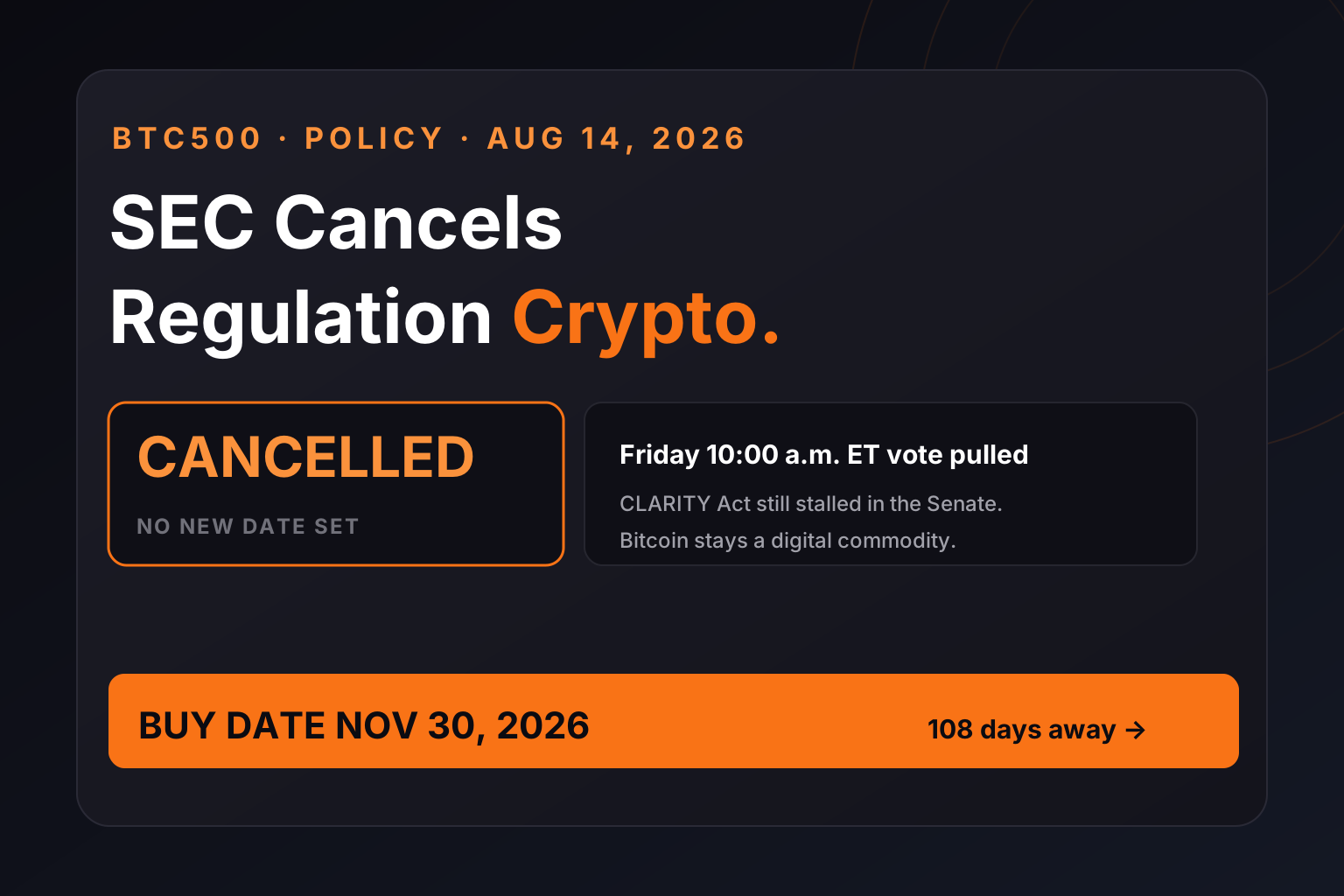
Key takeaway: This is a delay, not a reversal. The proposal Atkins outlined on March 17 still exists on paper. Congress still has the CLARITY Act stalled until at least mid-September. Bitcoin's status as a digital commodity is the most settled piece of the picture. The calendar does not move.
What was supposed to happen today
On August 10 the Commission posted a Sunshine Act notice for a single-item open meeting: Friday, August 14, 2026, at 10:00 a.m. ET, in Auditorium LL-002 at SEC headquarters on F Street in Washington, with a simultaneous webcast on sec.gov. The agenda titled the item Regulation Crypto Assets and assigned it to the Division of Corporation Finance.
The Commission was to consider whether to issue a proposing release — new rules creating a tailored offering regime for certain investment contracts involving crypto assets. That is not a final rule. A yes vote would have published the text for public comment and started notice-and-comment rulemaking. Final adoption, if it happens, was widely expected no earlier than 2027.
Late on August 13 the agency reversed course. The official cancellation notice, signed by Secretary Vanessa A. Countryman, states only that the meeting “has been cancelled.” A spokesperson told reporters the delay was due to an unforeseen scheduling issue and that the meeting would move to a later date. As of August 14, the Commission's events calendar still lists the session as cancelled and does not name a replacement.
What Regulation Crypto actually is
The cancelled meeting was the first chance to put on paper a framework Atkins previewed at the DC Blockchain Summit on March 17, 2026. He credited the design to Commissioner Hester Peirce's 2020 Token Safe Harbor. The speech did two things that matter for readers of this site.
First, it described a token taxonomy. Four categories are treated as not securities: digital commodities, digital collectibles, digital tools, and payment stablecoins under the GENIUS Act. Atkins said only one class remains a digital security in the ordinary sense: traditional securities that happen to be tokenized. His line — the Commission is “not the Securities and Everything Commission anymore” — is the policy shift in one sentence.
Second, it left Howey intact. A crypto asset that is not itself a security can still be offered as part of an investment contract. That is the gap Regulation Crypto was meant to fill: a compliant way for project teams to raise capital in the United States without a full Securities Act registration, and a rule-based exit once the team's essential managerial efforts have permanently ceased.
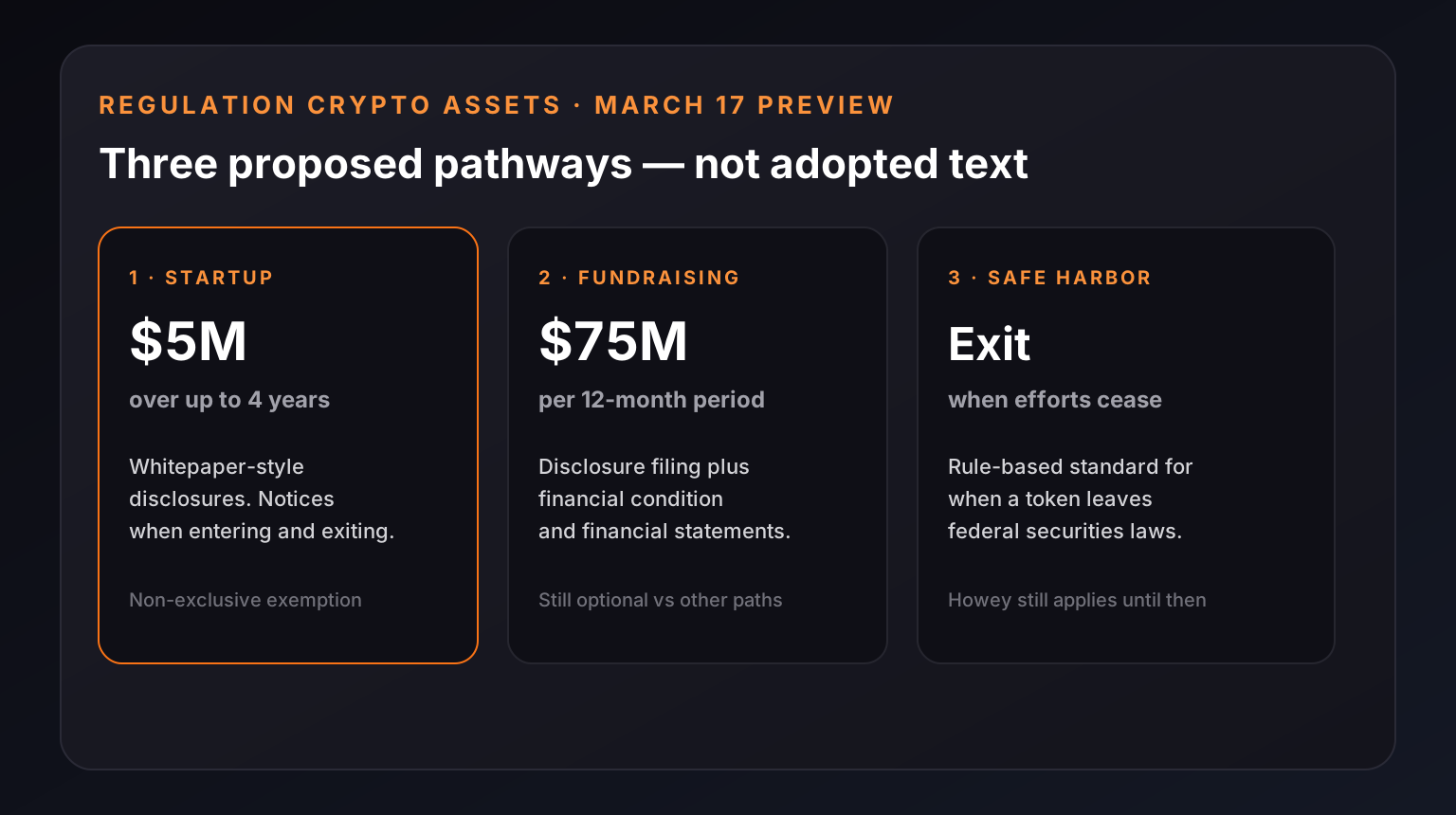
The March preview sketched three pathways:
- Startup exemption. A time-limited registration exemption — Atkins used “up to four years” and “say $5 million” — with principles-based, whitepaper-style disclosures posted on a public website and notices to the Commission when a team enters and exits the exemption. It would be non-exclusive: other capital-raising exemptions would remain available.
- Fundraising exemption. A larger offering path — “say $75 million” in any 12-month period — with a disclosure filing that adds the issuer's financial condition and financial statements.
- Investment-contract safe harbor. A rule-based standard for when a crypto asset is no longer subject to the federal securities laws: after the issuer has completed or permanently ceased the essential managerial efforts it represented it would perform.
Those dollar figures and time windows were illustrations in a speech, not adopted limits. Until a proposing release is published, no one outside the building has seen the actual text. That is what Friday was supposed to change.
A two-track delay, in the same week
The cancellation did not arrive in a vacuum. The Senate left Washington on August 8 for a five-week recess without a floor vote on the CLARITY Act, the market-structure bill that would put a statutory SEC/CFTC split around digital commodities like Bitcoin. Majority Leader John Thune filed a cloture motion that morning, queuing the bill for consideration when the chamber returns in mid-September. It still needs 60 votes.
Atkins has said only Congress can future-proof this area, and that any SEC exemptive rulemaking would be a head start on implementing legislation he expects to reach President Trump's desk. When both tracks pause in the same week, the industry is left asking which branch delivers first. CoinDesk put it that way on Thursday night. Neither answer is on the calendar today.
A second Atkins project is also delayed: the so-called innovation exemption for tokenizing securities and experimenting with new digital-asset business models. Reporting on August 13 said that proposal faces pushback from parts of Wall Street and the White House. Regulation Crypto and the innovation exemption are not the same rule, but they were the two concrete deliverables the market had circled for August.
What this does — and does not — mean for Bitcoin
Regulation Crypto is not a Bitcoin classification fight. Under the taxonomy Atkins described in March, Bitcoin sits in the digital-commodity bucket. Spot bitcoin ETFs already trade. The cancelled rule was about how other projects raise money when their token sale looks like an investment contract — not about whether BTC is a security.
The indirect channel is liquidity and risk appetite. When token issuers cannot raise cleanly in the United States, less speculative capital enters the long tail of the market. That often shows up as higher bitcoin dominance, not as a new fundamental for BTC itself. It can also keep the tape quiet. Bitcoin has spent weeks inside a roughly $62,000–$66,000 range; on the morning of August 14 it was near $63,350.
The structural bid that does matter for the cycle is still the one we covered this week: spot ETF demand and the newer income products that hold bitcoin rather than trade it. Goldman's $2.25 billion move into bitcoin income ETFs and the mid-August inflow rebound sit in a different bucket from a cancelled rulemaking. One is capital already allocated. The other is a process story about capital that has not been raised yet.
For a long-term holder, the useful distinction is simple. Policy can change how new tokens are issued. It does not change the block height of the next halving, the issuance cut at that height, or the date 500 days before it.
How a rules-based investor should think about it
Headlines about cancelled meetings are designed to feel urgent. The BTC500 rule is designed not to care. The next Bitcoin halving is still projected for April 2028 at block height 1,050,000 — the exact calendar date moves with average block time. The strategy still says buy exactly 500 days before that event and sell exactly 500 days after, around August 26, 2029.
From August 14, 2026, the official buy date of November 30, 2026 is 108 days away. That number does not change because a Friday vote was pulled. It does not change if the Senate takes up CLARITY in September, and it does not change if Regulation Crypto is reproposed in October. The strategy has been profitable in every completed cycle (2012, 2016, 2020). Past performance does not guarantee future results.
The bottom line on the delay: the first formal U.S. crypto offering rule of the Atkins Commission is on hold with no date. Congress is on recess. Bitcoin is still treated as a digital commodity, still held by ETFs, and still 108 days from the BTC500 buy window. Treat the cancellation as a process delay. Do not treat it as a new market signal.
See you in 108 days.
Nov 30, 2026 — the official BTC500 buy date
Check the live halving countdown, run the numbers on the investment simulator, and review every cycle on the timeline.
FAQ
What is Regulation Crypto?
Regulation Crypto Assets is the informal name for an SEC proposal to create a tailored offering regime for certain investment contracts involving crypto assets. Chair Paul Atkins previewed a three-part design on March 17, 2026: a small startup exemption, a larger fundraising exemption, and a safe harbor once a project team's essential managerial efforts permanently cease.
Why did the SEC cancel the August 14 meeting?
The official Sunshine Act notice dated August 13, 2026 says only that the 10:00 a.m. ET open meeting has been cancelled. A Commission spokesperson said the delay was due to an unforeseen scheduling issue and that the meeting would be moved to a later date. No new date has been announced.
Does Regulation Crypto change how Bitcoin is classified?
No. Atkins' March 2026 taxonomy treats Bitcoin as a digital commodity, not a security. The cancelled proposal was about how other crypto projects raise capital when a token sale is an investment contract. Spot bitcoin ETFs already trade under existing rules.
How is this different from the CLARITY Act?
CLARITY is a bill in Congress that would write an SEC/CFTC split into statute. Regulation Crypto is agency rulemaking that can start without new legislation. A statute is harder to reverse; a rule can be rewritten by a future Commission. Both tracks are paused this month — the Senate is in recess, and Friday's SEC vote was cancelled.
When will the SEC reschedule the vote?
Unknown. The Commission has not posted a replacement date. A proposing vote publishes a draft for comment; even after a rescheduled meeting, final adoption would still take months and was expected no earlier than 2027.
How does this relate to the next halving and the BTC500 buy date?
The next Bitcoin halving is projected for April 2028 at block height 1,050,000. The official BTC500 buy date is November 30, 2026 — exactly 500 days before that event. A cancelled SEC meeting does not move either date. From August 14, 2026, there are 108 days until the buy date.
Bottom Line
Friday was supposed to be the day the Atkins Commission put a crypto offering rule on paper. Instead the meeting was cancelled, the CLARITY Act remains a September problem, and Bitcoin is still rangebound in the low $60,000s. The process story is real. It is not a reason to rewrite a cycle rule.
The BTC500 strategy was built for weeks like this: the news cycle is loud, the issuance schedule is quiet, and the only date that matters is already on the calendar. November 30, 2026 is 108 days away. The Commission can pick a new Friday. The block clock does not wait for one.
Related Reading
- CLARITY Act Explained — the Senate bill that would put the SEC/CFTC split into statute, now queued for mid-September.
- Bitcoin This Week (Aug 24–31, 2026) — Jackson Hole, July Core PCE, ETF flows, and why institutional demand is still the tape.
- Goldman Sachs vs BlackRock — the $2.25 billion bitcoin income ETF fight happening while Washington stalls.
- Solar Eclipse and Bitcoin Halving — what rare predictable events teach about timing the market — and why the Aug 12 eclipse proved the same logic applies to the halving.
BTC500 is free educational software. Nothing on this page is financial advice. Historical performance does not guarantee future results. Halving-date projections depend on average block time.