Goldman Sachs is buying into the bitcoin income ETF business for $2.25 billion, an acquisition that expands the bank's derivative-powered ETF platform to $130 billion in total assets and positions it directly against BlackRock's rival income fund. The deal — reported August 12, 2026 — is the clearest sign yet that Wall Street is moving from “own bitcoin” to “manufacture a product that pays income from bitcoin” as institutional demand matures.
The structure matters more than the headline. NEOS — the ETF issuer Goldman is acquiring — runs a family of covered-call bitcoin ETFs that sell options on their bitcoin exposure to generate monthly income. Goldman's move turns the bank from a buyer of bitcoin ETFs into an operator of the yield products built on top of them. According to analysts cited by CoinDesk, the deal “takes direct aim at BlackRock's rival BITA fund” — a fund that pioneered the same income-generating category.
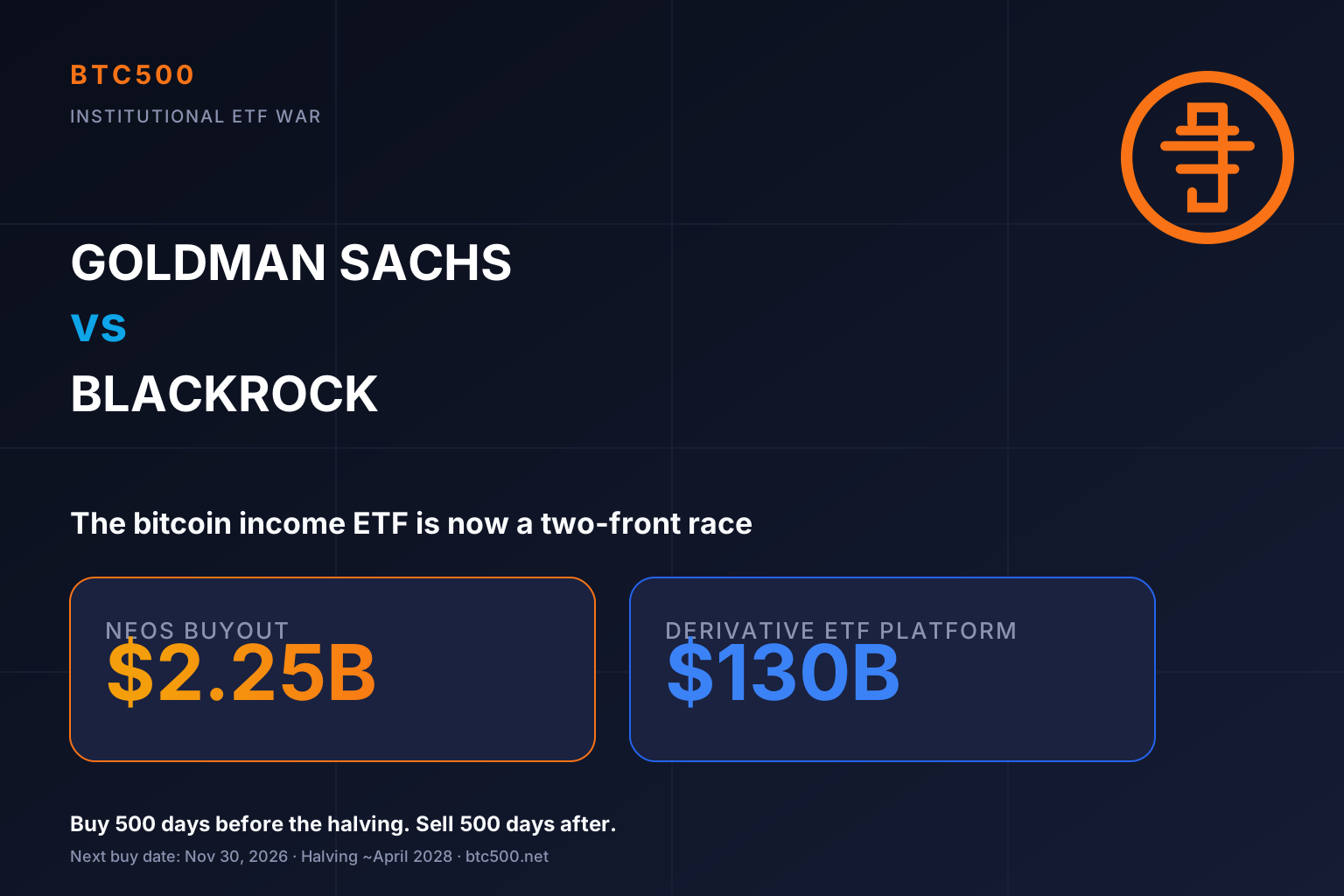
Key takeaway: The ETF race has entered a new phase. The first wave was about custody and exposure — who can hold bitcoin most efficiently. The second wave is about yield — who can manufacture income from the same bitcoin while keeping the exposure. Goldman just bought a seat at that table for $2.25 billion.
What a “bitcoin income ETF” actually is
A covered-call bitcoin ETF holds bitcoin exposure and simultaneously sells call options against it. The premium collected from those options becomes the “income” the fund pays out — usually monthly. In exchange, the fund caps its upside: if bitcoin rallies hard, the option buyer captures gains above the strike price.
That tradeoff is precisely why these products attract a different investor than a plain spot ETF. Retirees, wealth managers, and institutions that need cash flow but want bitcoin exposure can buy a product that pays while it holds. BlackRock saw this with BITA. Goldman is betting it can do it at scale — and across its entire $130 billion derivative platform.
Why this is a war, not a product launch
The numbers frame the competition. Goldman's NEOS deal pushes its ETF platform to $130 billion in assets, per analyst estimates. BlackRock's bitcoin income fund already owns the category's first-mover position. Both are now competing for the same institutional allocation dollars — and for the custody relationships underneath them.
The other heavyweight is moving in the opposite direction — temporarily. Strategy (formerly MicroStrategy) sold 1,690 BTC in a share-sale raise of $653 million, growing its dollar reserves to $4.65 billion while its treasury still holds 840,447 BTC. Its CEO says accumulation will resume this year; the firm has bought 175,000 BTC and sold just 7,000 since January — a net buyer by a factor of 25x.
Add Fidelity's filing to add staking to its nearly $900 million ether ETF, and the institutional picture sharpens: the biggest asset managers are all building yield, income, and staking layers on top of crypto exposure. Spot products were the opening move. Income products are the follow-up — and the race just got a new favorite.
The supply math behind the noise
Strip out the brand-name headlines and the signal is about who holds bitcoin — and how long they hold it. A covered-call fund holds its bitcoin position; it doesn't trade it away for income. A staking-enabled ether ETF holds and locks its ether. Both reduce the float available to short-term traders.
This matters even more as the halving approaches. The next halving — projected for April 2028 at block height 1,050,000 — cuts new supply issuance in half. When daily ETF demand is already running at multiples of daily miner issuance, and the newest institutional products hold rather than trade, the supply side of the equation tightens in both directions: less new supply entering, more supply leaving the active float.
Bitcoin itself was trading near $64,000 on August 12, 2026, holding steady after US CPI inflation slowed to 3.4% as expected — with September Fed rate-pause odds near 60%. The macro backdrop remains the tide; the ETF custody race is the current beneath it.
How a rules-based investor should think about it
For the BTC500 strategy, the ETF war is a confirmation, not a new signal. Each new institutional product — spot, then income, then staking — adds demand that is structural rather than speculative. That is exactly the kind of holder behavior that historically strengthens the halving cycle: fewer coins available, held for longer, by buyers who don't exit on red days.
What the ETF war does not do is change the date. The strategy still says buy 500 days before the halving — November 30, 2026 — and sell 500 days after, around August 26, 2029. Institutions debate product design; the calendar doesn't care which fund wins.
The bottom line on the ETF war: Goldman's $2.25 billion NEOS buyout turns the bitcoin income ETF category into a genuine two-front competition with BlackRock, on a $130 billion platform. The category's defining trait is that it holds bitcoin while paying income — the opposite of speculative trading. For a cycle-timed investor, that is structurally supportive supply behavior heading into a halving, and it changes nothing about the buy date. 110 days to go.
See you in 110 days.
Nov 30, 2026 — the official BTC500 buy date
Check the live halving countdown, run the numbers on the investment simulator, and review every cycle on the timeline.
FAQ
What is the Goldman Sachs NEOS deal?
Goldman Sachs is acquiring NEOS, an ETF issuer focused on covered-call bitcoin income products, in a transaction valued at $2.25 billion. The deal expands Goldman's derivative-powered ETF platform to roughly $130 billion in total assets, per analysts, and positions the bank directly against BlackRock's BITA income fund.
What is a bitcoin income ETF and how does it work?
A bitcoin income ETF (typically a covered-call fund) holds bitcoin exposure and sells call options against it, collecting option premiums that are paid out as income. It trades away some upside in exchange for regular cash flow.
Why is Goldman buying into bitcoin income ETFs?
Goldman is competing for the same institutional allocation dollars as BlackRock. Income-generating bitcoin products appeal to wealth managers and institutions that want exposure plus cash flow, and Goldman's $130 billion derivative platform gives it distribution scale to make the category its own.
Does the ETF war affect the bitcoin price?
Indirectly, on the supply side. Income and staking products hold their bitcoin or ether rather than trading it, which tightens available float at a time when spot ETF daily inflows are already running at multiples of daily mining issuance.
How does this relate to the next halving and the BTC500 buy date?
The next Bitcoin halving is projected for April 2028 at block height 1,050,000. The official BTC500 buy date is November 30, 2026 — exactly 500 days before the halving. Institutional products that hold bitcoin reduce float and tend to strengthen the halving-cycle dynamics the strategy is built around. From August 12, 2026, there are 110 days until the buy date.
Bottom Line
Goldman's $2.25 billion move into bitcoin income ETFs turns a product niche into a two-front institutional war. Covered-call funds hold bitcoin and pay income; staking ETFs lock ether. Both behaviors reduce sellable float — a structural tailwind heading into the April 2028 halving.
The BTC500 strategy was built for exactly this kind of market: institutional noise is rising, but the rule stays fixed. November 30, 2026 is 110 days away. The ETF platforms will keep competing for allocation. The calendar is waiting for everyone.
Related Reading
- SEC Cancels Regulation Crypto Vote — Friday's offering-rules meeting was pulled with no new date; Bitcoin's classification does not change.
- Bitcoin This Week (Aug 24–31, 2026) — Jackson Hole, July Core PCE, ETF flows, and why institutional demand is still the story.
- Bitcoin's Strongest Hands Are Back — 90 elite wallets now hold 10,000+ BTC each as accumulation continues through the noise.
BTC500 is free educational software. Nothing on this page is financial advice. Historical performance does not guarantee future results.